You can't transcribe what you can't legally record. Or worse: you can record it, you can transcribe it, and still not be allowed to use it.
Recording consent is the boring step people skip until the day they need it, the moment a podcast guest asks for a quote to be pulled, or an IRB reviewer wants the form on file, or a source decides after the call that one stretch should have been off the record. The cleanest defense is a one-page document the subject signed before you hit record.
These are the templates I wish I'd had on my first ten interviews. They're written for US use, plain English, and short enough that nobody refuses to read them.
This post isn't legal advice. Recording laws vary by state, and the right form for a clinical, HR, or minors' interview is different from the templates here. When the stakes are real, run it past counsel.
What every recording consent form should include
Six things, in this order:
- Who's recording, and on whose behalf.
- What's being recorded: audio, video, or both, and the date.
- Why the recording is being made. "A podcast episode" is different from "a peer-reviewed publication" is different from "internal notes only."
- Who will hear or see it. Editors, producers, co-researchers, the public.
- How long it'll be kept and where it's stored.
- The subject's rights: to stop, to redact, to withdraw, to receive a copy.
The common mistake is writing a form so broad it covers everything in theory. Subjects who feel railroaded by a one-paragraph "I agree to anything you do with this" disclaimer are the ones who walk back quotes later. Be specific and they'll sign.
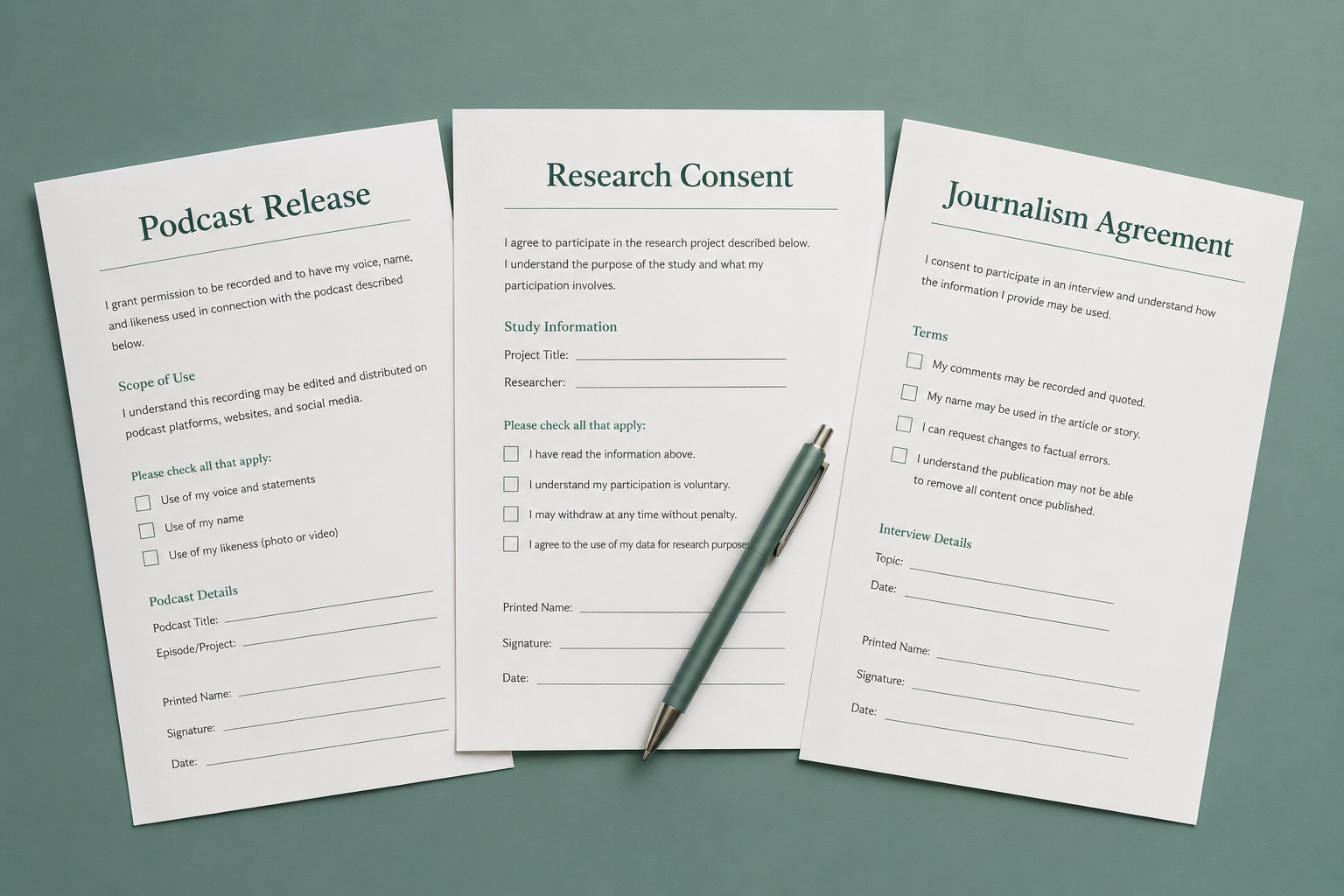
Template 1: Podcast guest release (short form)
Use this for guests on a public podcast or video show. Copy it, fill in the brackets, and email it 48 hours before the interview.
Guest Release — [Show Name]

I, [Guest Full Name], agree to be recorded by [Host/Company]
on [Date] for an episode of [Show Name].

I understand:
- The recording (audio and any video) will be edited and released
  publicly on [Platforms: e.g. Apple Podcasts, Spotify, YouTube].
- Excerpts may be used in promotional clips, transcripts, and
  social media.
- The recording will be retained by [Host/Company] indefinitely
  unless I request removal in writing.

I confirm I have the right to grant this release and that the
opinions I express are my own.

If I wish to retract a specific quote or section, I will contact
[email] within 14 days of release. The host will consider the
request in good faith but has final editorial discretion.

Guest signature: _______________________  Date: __________
Host signature:  _______________________  Date: __________
If you're paying the guest or assigning specific image rights, add a one-line payment and likeness clause. For most independent shows, this is enough.
Template 2: Qualitative research interview consent
This is the form a US IRB will expect to see for a non-clinical, minimal-risk study. Most low-risk interviews are reviewed as expedited or exempt, but you still need the document signed and stored.
Informed Consent — [Study Title]

Principal Investigator: [Name, Department, Institution]
Contact: [email] / [phone]

Purpose. You are invited to participate in a research study
about [topic]. The purpose of the study is [one sentence].

What you'll do. You'll take part in an interview of about
[duration]. The interview will be audio-recorded with your
permission.

Risks and benefits. The risks of participating are minimal:
[discomfort discussing X / time spent]. You will not be paid
for participation. [Or: You will receive $XX as compensation.]

Confidentiality. The recording and transcript will be stored on
[encrypted drive / institutional server]. Only [PI / research
team] will have access. Your name will be replaced with a
pseudonym in any publication, and identifying details will be
removed. Recordings will be deleted after [N] years.

Voluntary participation. You can stop the interview at any time,
skip any question, or withdraw your consent at any point up to
[date]. After that, your already-anonymized data may remain in
the dataset.

Questions about the study: [PI contact].
Questions about your rights as a research subject: [IRB contact].

By signing below, I confirm I am 18 or older, I have read this
form, and I agree to participate, including being audio-recorded.

Participant signature: _______________________  Date: __________
PI signature:          _______________________  Date: __________
Two notes from experience. First, never bury the "you can stop at any time" line. Read it out loud at the start of the interview. Subjects relax, and you get a better transcript. Second, if you're using the audio for an interview in a research paper, confirm the pseudonym scheme with your IRB before you publish, not after.
Template 3: Journalism interview agreement
For an on-the-record interview where the subject understands they'll be quoted by name. Reporters often rely on verbal agreement, but for sensitive sources or feature interviews, a short written confirmation is worth keeping.
Interview Confirmation — [Publication]

Reporter: [Name], [Publication]
Subject: [Name, Title]
Date and time: [DateTime]

This message confirms our interview will be:

[ ] On the record. Quoted by name, attributed to your role.
[ ] On background. Paraphrased, attributed only as e.g.
    "a senior engineer at the company."
[ ] On deep background. Used to inform reporting; no
    attribution.
[ ] Off the record. Not for publication; for the reporter's
    understanding only.

The interview will be recorded for accuracy. The recording will
not be published; only the resulting article.

If during the conversation either of us wishes to move a portion
to a different attribution, we'll say so in the moment. Changes
after the fact will be considered in good faith but at the
publication's discretion.

Confirm by reply: "I agree."
The four-tier attribution language is more careful than most casual interviews need, but it's the language that protects both sides when something goes sideways. Use it for feature pieces, investigative work, and anything where a source's reputation is in play.
The one-line verbal consent (when a paper form isn't realistic)
For unscheduled phone interviews, hot-mic field reporting, or vox-pop street interviews, a written form isn't realistic. Capture verbal consent on the recording itself, before the first substantive question:
"Confirming on the recording: this is [Reporter Name] with [Publication]. The date is [Date]. I'm speaking with [Subject Name]. You understand we're recording this for the purposes of [story / podcast / research], and you agree to be recorded. Is that correct?"
Pause. Wait for the verbal yes. Then move on.
States that require all-party consent (the Reporters Committee for Freedom of the Press keeps a current 50-state map) treat that exchange as the legal floor for telephone recording. The federal rule is one-party consent. But if you're in a one-party state calling someone in California, the California rule applies. Default to all-party consent and you'll never have to relitigate.
Where the form ends and the transcript begins
The consent form covers permission. It doesn't transcribe the conversation. Once the interview is done, you'll pull a clean transcript from the recording, and then the boring sequel begins: cleanup, pseudonyms, coding, quotes. If you've never built that pipeline, the interview transcript template is a reasonable starting point, and for oral histories specifically there's a step-by-step guide on transcribing them.
Two operational habits that matter more than they sound:
- Store the signed form in the same folder as the transcript, not in your inbox. If you're ever asked for it three years later, you want them together.
- Date-stamp the transcript filename to match the consent form. Future you, going back to find one quote, will thank present you.
Paste any public link or upload a file and get a clean transcript in minutes. First 3 clips every month are on us — no card required.
Common pitfalls to avoid
- Recording before the form is signed. Even if the subject verbally agreed, a half-recorded interview with no paper trail is harder to defend than no recording at all.
- One form for everything. A guest release is not a research consent. A research consent is not a journalism agreement. The genre matters because the audience, the storage, and the right to withdraw all differ.
- Vague retention language. "Stored securely" means nothing. Name the system, name the duration.
- Legalese over English. If the subject can't read the form in one pass, they'll either refuse or sign without understanding. Both are bad. Write the form at the same reading level as your interview questions.
- Forgetting the federal/state mismatch. The strictest rule in play is usually the one that applies. When in doubt, get all parties on the record agreeing.
Sources
- Reporters Committee for Freedom of the Press — A Reporter's Recording Guide
- U.S. Department of Health & Human Services — Office for Human Research Protections, Informed Consent FAQs
- Society of Professional Journalists — SPJ Code of Ethics
- American Association for Public Opinion Research — Code of Ethics
- Justia — State Recording Laws Overview