AssemblyAI is the speech-to-text API I reach for when a team needs a serious transcription backend without running their own Whisper boxes. If you're a developer, the answer is short: it's one of the best dev-focused options out there, and the SDKs and docs are unusually good. If you're a non-coder hunting for a tool to drop a meeting recording into, this isn't the product for you. You'd be paying for an API key when you really want a web app.
That's the whole review in a paragraph. The rest is detail.
What does AssemblyAI actually do?
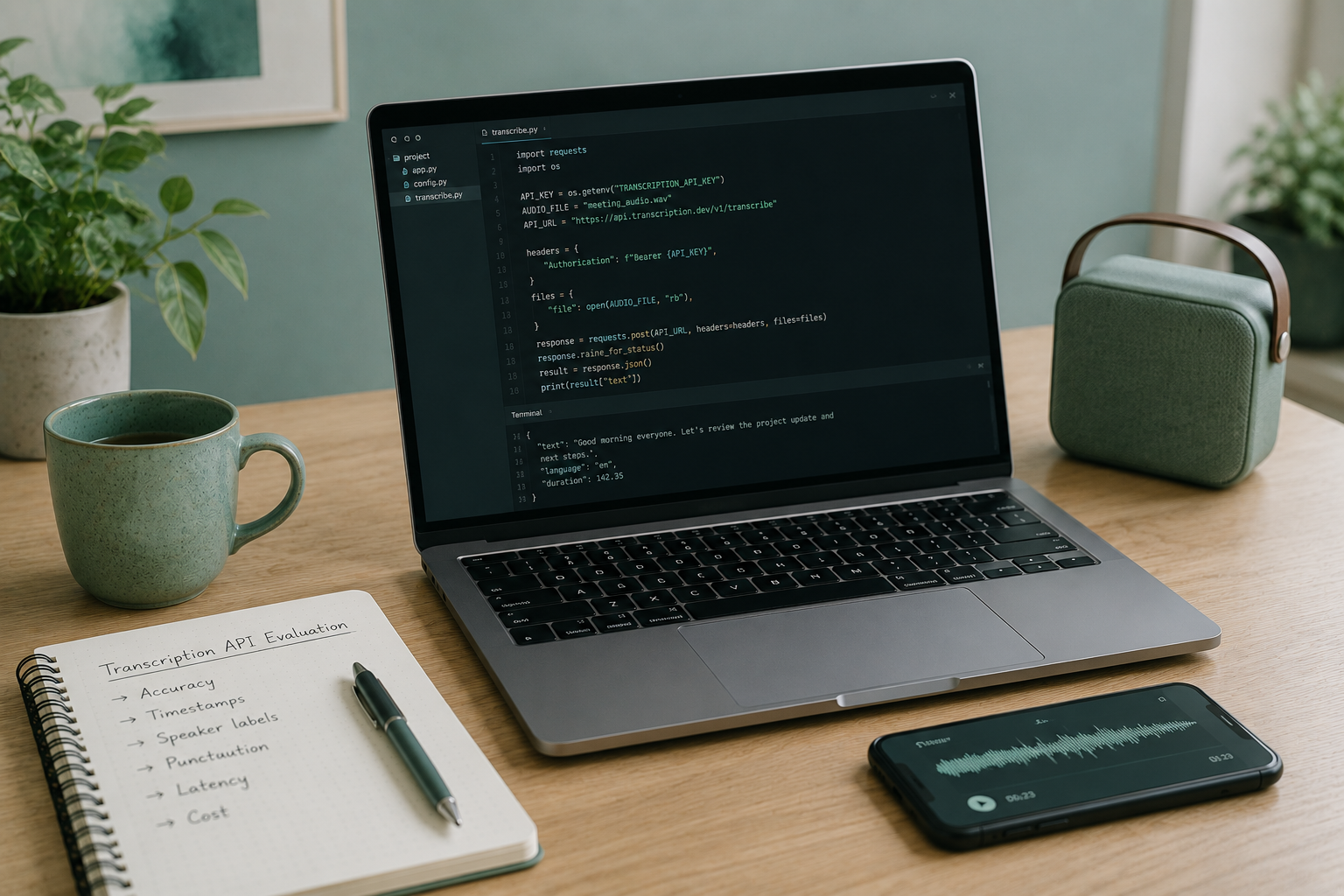
AssemblyAI is an API. You send it audio, it sends back JSON: a full transcript, word-level timestamps, and a stack of layered features like speaker diarization, auto chapters, sentiment, content moderation, entity detection, and summarization. There's also a real-time WebSocket stream for live captions and voice agents.
It isn't a place you upload an MP3 and watch a progress bar. It's the engine under that progress bar. That distinction matters for who this is for.
What is AssemblyAI good at?
The accuracy is genuinely competitive. Their Universal model holds up well against Whisper-large on clean US English, and it usually pulls ahead on calls and meeting audio with overlapping voices. Speaker labels are reliable enough that I don't second-guess them on a two-person interview the way I do with some competitors. If you're new to that feature, our plain-English guide to speaker diarization covers what it actually does under the hood.
The auxiliary features are where it earns the developer love. Auto-chapters are useful for long-form content. The summarization endpoint produces structured output you can actually use, instead of five generic bullet points. Real-time streaming has low enough latency to feel responsive.
The docs are the unsung win. Code samples in every common language, working examples, and the SDKs handle the polling-vs-webhook async dance for you.
Where does AssemblyAI fall short?
Three honest limits.
First, languages. AssemblyAI's coverage skews heavily to English and a handful of European languages. If your audio is Tagalog, Vietnamese, or any low-resource language, Whisper or Google STT will outperform it. Test before you commit.
Second, it's an API only. There is no end-user web app where a researcher can drop a Zoom file and grab a transcript. If your stack needs that, you're building the front end yourself or layering it under a tool that already does, which is what most consumer transcription products quietly do.
Third, edge cases on noisy field recordings. AssemblyAI is great on phone calls and meetings. On a windy outdoor interview from a phone, accuracy drops faster than you'd hope, and the recovery curve isn't as graceful as Whisper-large-v3 with proper voice-activity preprocessing. If field audio is your bread and butter, run a test batch first.
How much does AssemblyAI cost?
Async transcription is priced by audio duration, and it's cheap by the standards of the developer API market: fractions of a cent per minute on the standard tier, with the higher-tier Universal model a bit more per hour. Real-time streaming is metered separately and costs more per minute than async, which is normal across the industry.
The cheapness is the headline. Compared against running your own Whisper-large on a GPU you rent by the hour, AssemblyAI usually wins on cost-per-minute for low-to-medium volume, and the operational headache is zero. At very large scale, self-hosting flips ahead, but you have to actually want to run that infrastructure.
There's a free tier with credits to test with. Use it. Run your real worst-case audio through it before signing anything. For broader pricing context across providers, see how much AI transcription really costs.
Who should use AssemblyAI?
Developers building a product where transcription is a feature: meeting tools, sales-coaching apps, podcast platforms, voice agents. If you're shipping software and you need transcription inside it, AssemblyAI saves you weeks of GPU plumbing.
It is not the right tool for:
- A journalist or researcher who needs a UI to upload files. Pick a hosted transcription service.
- A team that needs deep multilingual support including low-resource languages. Look at Whisper or a translation-focused service.
- A solo creator who just wants a transcript for a single YouTube video. Massively overkill.
AssemblyAI vs the alternatives
The honest comparison isn't AssemblyAI vs Otter. They're different products. It's AssemblyAI vs Deepgram, Google STT, AWS Transcribe, and rolling your own Whisper.
- Deepgram — the other serious dev-focused API. Often faster on real-time, sometimes cheaper. Slightly less feature-rich on the post-transcription side.
- Google STT — solid baseline and broad language coverage, but the dev experience and feature set feel less modern.
- AWS Transcribe — fine if you're already deep in AWS. Otherwise unremarkable.
- Self-hosted Whisper or faster-whisper — cheaper at scale, more language coverage, no per-minute fee. But you own the GPU, the queue, the failure modes, and the upgrade treadmill. See Whisper vs faster-Whisper if you're weighing the self-host path.
The right pick depends on your volume, your latency needs, and how much infra work you want to own.
Should you actually use AssemblyAI?
Yes, if you're shipping a product and want a clean API with good features and competitive accuracy without running infrastructure. Free tier first, your real audio second, then commit.
No, if you're a person trying to transcribe a file. In that case, you want a tool with a UI. Try transcribing a file in VTS and you'll see what I mean. (Full disclosure: VTS is our product. It uses Whisper under the hood, not AssemblyAI.) The decision tree is genuinely that simple: ship code, use an API; get a transcript, use a tool.
Paste any public link or upload a file and get a clean transcript in minutes. First 3 clips every month are on us — no card required.