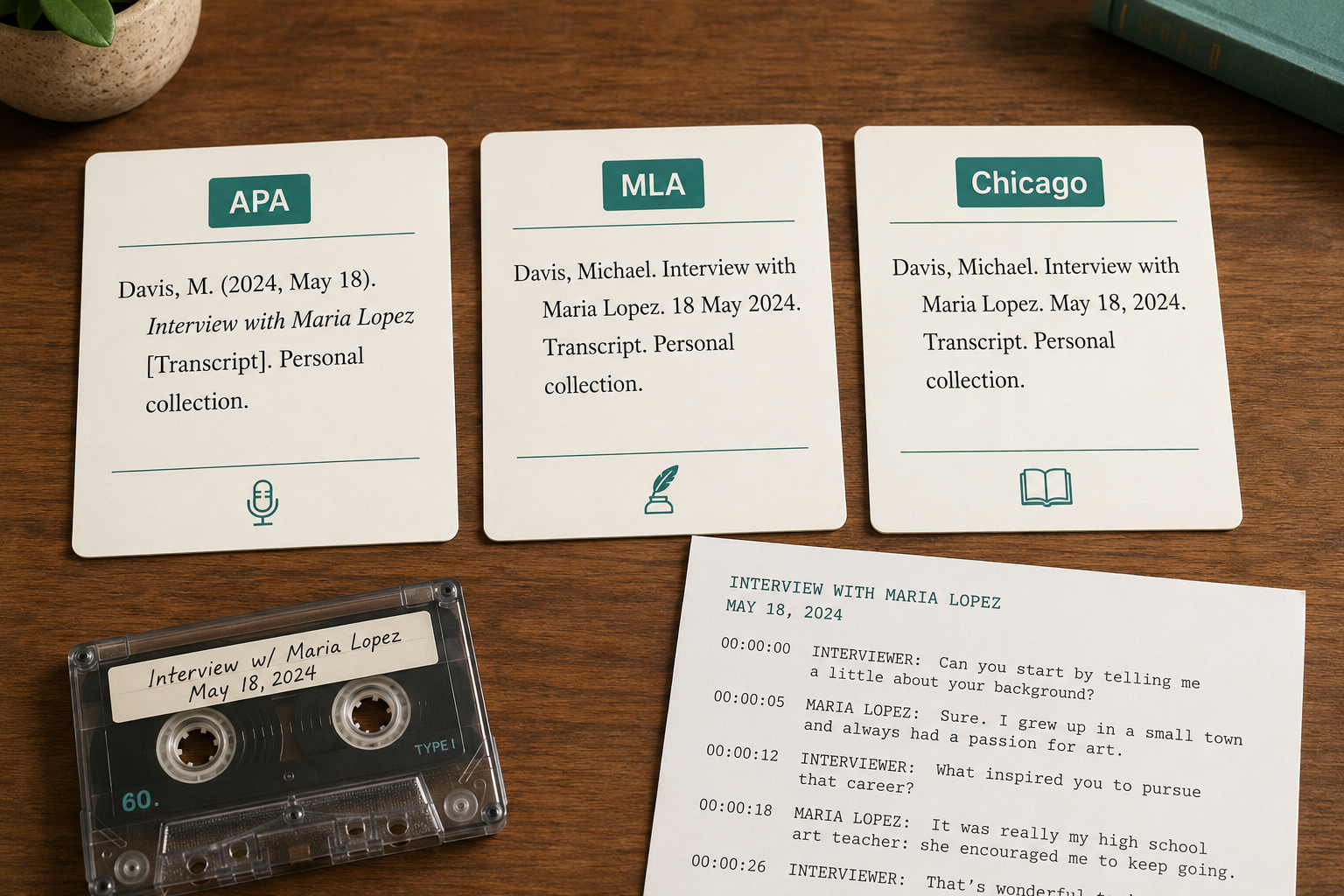
Cite an interview transcript wrong and a reviewer notices fast, usually because the citation either suggests the source is unrecoverable when it isn't, or treats a private conversation as if it's been archived. APA, MLA, and Chicago each handle this differently, and a transcript sits in the awkward middle space between "personal interview" and "primary source document."
The short version, then the details.
In APA 7, an unpublished interview is cited in-text only, no entry in the reference list. If you've archived the transcript (university repository, public dataset, or a citable URL), cite it like a published document and give the reader the recovery path. MLA 9 wants the format ("Personal interview" or the type of recording) and the date; if archived, treat it like any other source from that archive. Chicago is the most flexible: a transcript that lives somewhere retrievable gets cited like any other archived document, with the timestamp pointing into the audio when you quote.
The decision that drives everything else is whether the transcript is recoverable. Get that right first.
How APA cites interview transcripts
APA 7 draws a sharp line between recoverable and unrecoverable sources. A live conversation you recorded for your own research and didn't deposit anywhere is treated as personal communication. It appears only in the body of the paper, never in the reference list:
(J. Romero, personal communication, October 14, 2025)
If you've deposited the transcript in a repository or your institutional archive, it becomes a recoverable source and earns a full reference entry. Format it like the closest analog the APA template covers, typically an unpublished manuscript or an archived dataset:
Romero, J. (2025). Interview with J. Romero [Transcript]. UCLA Oral History Center. https://oralhistory.library.ucla.edu/...
The shift from "personal communication" to a full citation is also a methodological signal. It tells the reader the data can be revisited. For peer review, that matters.
How MLA cites interview transcripts
MLA 9 is built around its core elements template (Author, Title, Container, Version, Number, Publisher, Date, Location). A transcript fits in cleanly. The interviewee is the author. The title is the title of the interview if it has one, otherwise a descriptive title in plain text. The container is the archive or publication that holds it:
Romero, Jordan. Interview. Conducted by the author, 14 Oct. 2025. UCLA Oral History Center, https://oralhistory.library.ucla.edu/...
For an unpublished interview you conducted yourself, MLA accepts a simpler form with "Personal interview" as the type and the date, no container needed:
Romero, Jordan. Personal interview. 14 Oct. 2025.
If the transcript is bound into your thesis or dissertation as an appendix, cite the interview as personal and refer the reader to your own appendix in-text.
How Chicago cites interview transcripts
Chicago is the friendliest to transcripts because it already handles archived oral histories well. The Notes-Bibliography style treats a transcript like any other archived document. The full note:
Jordan Romero, interview by the author, October 14, 2025, transcript, UCLA Oral History Center, https://oralhistory.library.ucla.edu/...
The bibliography entry inverts the name and drops the comma after the surname per Chicago convention.
For Author-Date (closer to APA), the parenthetical is (Romero 2025) with the full entry in the reference list. If the transcript isn't archived anywhere and you have the file on your laptop and nothing more, Chicago lets you cite it as an unpublished interview in a note, with no bibliography entry.
When to call it a "personal interview" vs an archived transcript
A "personal interview" or "personal communication" tag is shorthand for the reader cannot retrieve this. Use it when nobody but you has the recording, and you have no plan to deposit it. That covers the bulk of journalism work and a lot of working-paper drafts.
For published research, push toward the archived form whenever the ethics protocol allows. Anonymize and redact what needs it, then deposit. The citation gets longer; the work becomes auditable. We wrote a longer walkthrough of the interview-to-paper pipeline that researchers actually use, including the steps that come before citation.
A practical note: if you're doing oral history interviews, the archive is the whole point. Cite to the archive, and reference the accession number in the location field.
Should you include a timestamp in the in-text citation?
When you're quoting a direct passage and your transcript has timestamps tied to the audio, yes, include the timestamp. It functions the same way a page number does for a print source: it lets the reader find the moment you're quoting.
APA-style with a timestamp:
(Romero, personal communication, October 14, 2025, 00:23:11)
MLA in-text with a timestamp from an archived recording:
(Romero 00:23:11)
In Chicago, the timestamp goes at the end of the footnote, after the URL.
If your transcript doesn't have timestamps, this is the moment to add them. We covered why timestamped transcripts pay for themselves in any project that will eventually be cited; citation is one of the reasons.
Where to put the full transcript: appendix, archive, or supplemental file
Three honest options.
The thesis or dissertation appendix works when the work is bounded and the institution stores it. The full transcripts (anonymized) sit at the back. Citations point to your own appendix. Most universities accept this; some require it.
A public or institutional archive is the gold standard for published research, especially in oral history, qualitative health research, and policy work. The transcript gets a permanent URL or accession number. Anyone who reads your paper can retrieve and re-analyze the data. This is what Chicago and MLA most cleanly support.
A journal supplemental file works for shorter, anonymized excerpts when the journal allows it. Read the journal's data sharing policy first; some require deposit in a recognized repository rather than a supplemental PDF.
Whichever you choose, your recording consent forms need to authorize it before the interview happens. Retrofitting consent later is painful and sometimes blocking.
Anonymizing participants without breaking the citation
When the citation calls for the interviewee's name and the IRB protocol forbids identifying them, you cite the pseudonym and document the convention in your methods section: "Participants are referred to by pseudonym throughout (see Table 1 for the pseudonym-to-condition mapping)." The reader can still follow which quote came from which participant, and the trail back to the raw data is preserved through your archive's controlled access, not through the public citation.
For sensitive work (clinical, legal, vulnerable populations), the archive itself is restricted access. Your citation gives the repository and the access procedure ("on request, with IRB approval") in place of a direct URL.
A clean transcript makes all of this easier. If you're at the stage of preparing your interviews for citation and need to transcribe an interview cleanly first, speaker-labeled and timestamped, start there and worry about the citation form once the text exists.
Paste any public link or upload a file and get a clean transcript in minutes. First 3 clips every month are on us — no card required.