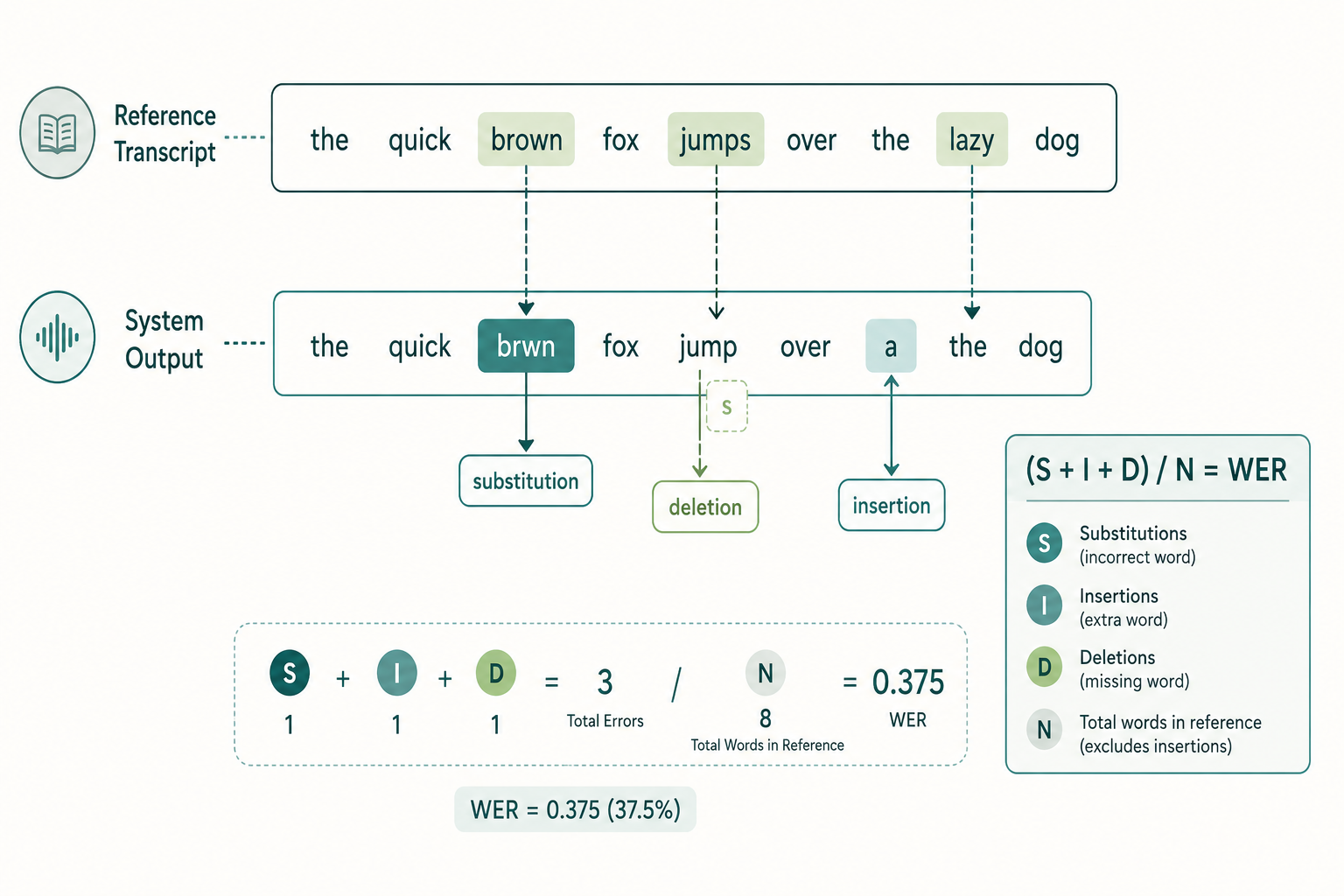
Word error rate (WER) is the percentage of words a speech-to-text system gets wrong compared to a careful human reference. A 10% WER means roughly one in ten words is off. Every "95% accurate" claim you've seen on a transcription product page is WER in different clothes.
The trouble is that WER hides almost everything you actually care about. A transcript with 5% WER can still be unreadable if the 5% are the wrong words. Here's what the number means, when to trust it, and when to look past it.
How Word Error Rate Is Actually Calculated
WER counts three kinds of mistakes in the system's output: substitutions (it wrote "court" instead of "caught"), insertions (it added a word that wasn't said), and deletions (it skipped a word that was said). Sum those, divide by the number of words in the reference, multiply by 100.
Count substitutions (S): words in the reference that the system replaced with a wrong word.
Count insertions (I): words the system added that weren't in the reference.
Count deletions (D): words in the reference the system skipped.
Add them: total edits = S + I + D.
Divide by N (words in the reference). Multiply by 100 to get WER as a percentage.
The arithmetic is the easy part. The politics is in deciding what counts as the "right answer" — your reference transcript needs to be carefully made by a human, and even humans disagree about filler words and false starts.
What a Good WER Score Looks Like
Numbers vary wildly by audio. On clean, single-speaker English read out loud, modern systems hit 3–5% WER. On real-world phone calls with crosstalk, accents, and background noise, the same systems often run 12–20%. OpenAI's Whisper paper reports WER ranges that span an order of magnitude across datasets — same model, very different scores.
The takeaway: treat WER as a relative score, not an absolute one. Compare two systems on your audio, not on the LibriSpeech leaderboard. A model that wins on read audiobooks may not win on your noisy Zoom recording.
Why WER Lies (or At Least Misleads)
WER weighs every error the same. A missed "uh" counts the same as a misspelled name. A flipped negative — the witness said they did see the suspect, the transcript says they didn't — moves the score by maybe one percentage point and changes the meaning of the document.
A few specific blind spots:
- Casing and punctuation. Most WER scoring lowercases and strips punctuation before comparing. A transcript with no commas scores the same as one with perfect punctuation. Readability isn't measured.
- Speaker labels. Diarization errors don't show up in WER at all. If the system attributes the wrong line to the wrong person, the words may be right but the conversation is wrong. How to transcribe a Zoom recording with multiple speakers goes deeper on why this matters.
- Proper nouns. Names, places, and jargon are where systems fail hardest, and where a small WER bump hides the worst reading experience. See why AI transcripts get names wrong.
- Substantive vs cosmetic errors. Two transcripts can share an 8% WER and be wildly different documents. One might smear common contractions ("I'm gonna" vs "I am going to"). The other might invent a brand name out of thin air.
If the transcript is going to be used for evidence, research, or anything someone will rely on, the WER number alone isn't enough. Read the output for substantive errors before you trust it.
How to Test WER on Your Own Audio
You don't need a research budget. You need 60 seconds of audio that looks like the audio you actually have, and a careful human transcript of it.
Pick a 1-minute clip that matches the worst audio you actually deal with: the noisy room, the accent, the crosstalk.
Transcribe it carefully by hand. This is your reference.
Run the same clip through each system you're evaluating.
Use the jiwer Python library to compute WER against your reference, or just diff the two transcripts in a text editor and count by hand.
Then read the system's transcript end to end. Did the meaning survive? That matters more than the percentage.
If you'd rather see what a system does on your file before you start scoring it, you can transcribe a sample directly in the browser and read what comes out.
Word Error Rate vs Character Error Rate vs Sentence Error Rate
WER isn't the only metric. Here's where each one fits:
| Metric | What it measures | When to use |
|---|---|---|
| WER (Word Error Rate) | Word-level edits to match the reference | Default for English speech |
| CER (Character Error Rate) | Character-level edits | Languages without clear word boundaries (Chinese, Japanese); catching misspelled proper nouns |
| SER (Sentence Error Rate) | Percentage of sentences with any error | Rarely useful — too coarse |
For English audio, WER is the right starting point. For multilingual content, check CER as well — it'll catch the near-miss spellings that WER counts as full substitutions.
How to Lower the WER You Actually Get
You can't make a model smarter, but you can feed it better input. The biggest WER reductions on real-world audio almost always come from the recording, not the model.
- One mic per speaker beats one room mic, every time. Crosstalk is the most expensive error source there is.
- 16 kHz mono WAV or FLAC; don't pre-compress to 64 kbps MP3 if you can help it. The best audio format for AI transcription walks through the trade-offs.
- Room treatment. Even a closet with a duvet kills reverb, which kills word boundaries.
The model matters too. On the same audio, a larger Whisper model will reliably beat a tiny one. Faster-whisper vs OpenAI Whisper gets into where the speed-vs-accuracy curve actually bends.
Common Misconceptions About WER
"99% accurate" marketing claims mean 1% WER, almost always measured on a benchmark that does not look like your audio. Treat those numbers as upper bounds, not predictions.
"Whisper got X% on LibriSpeech" is true and almost meaningless for your meeting recording. LibriSpeech is read audiobooks. Your audio is not read audiobooks.
"WER under 10% is fine" depends entirely on what the transcript is for. For a personal note, sure. For a legal record, no. What to actually expect from transcription accuracy goes through the use-case mapping.
"Lower WER is always better." A model that's slightly worse on WER but better on proper nouns may produce a much more useful transcript. The number is a proxy; the document is the product.
Paste any public link or upload a file and get a clean transcript in minutes. First 3 clips every month are on us — no card required.