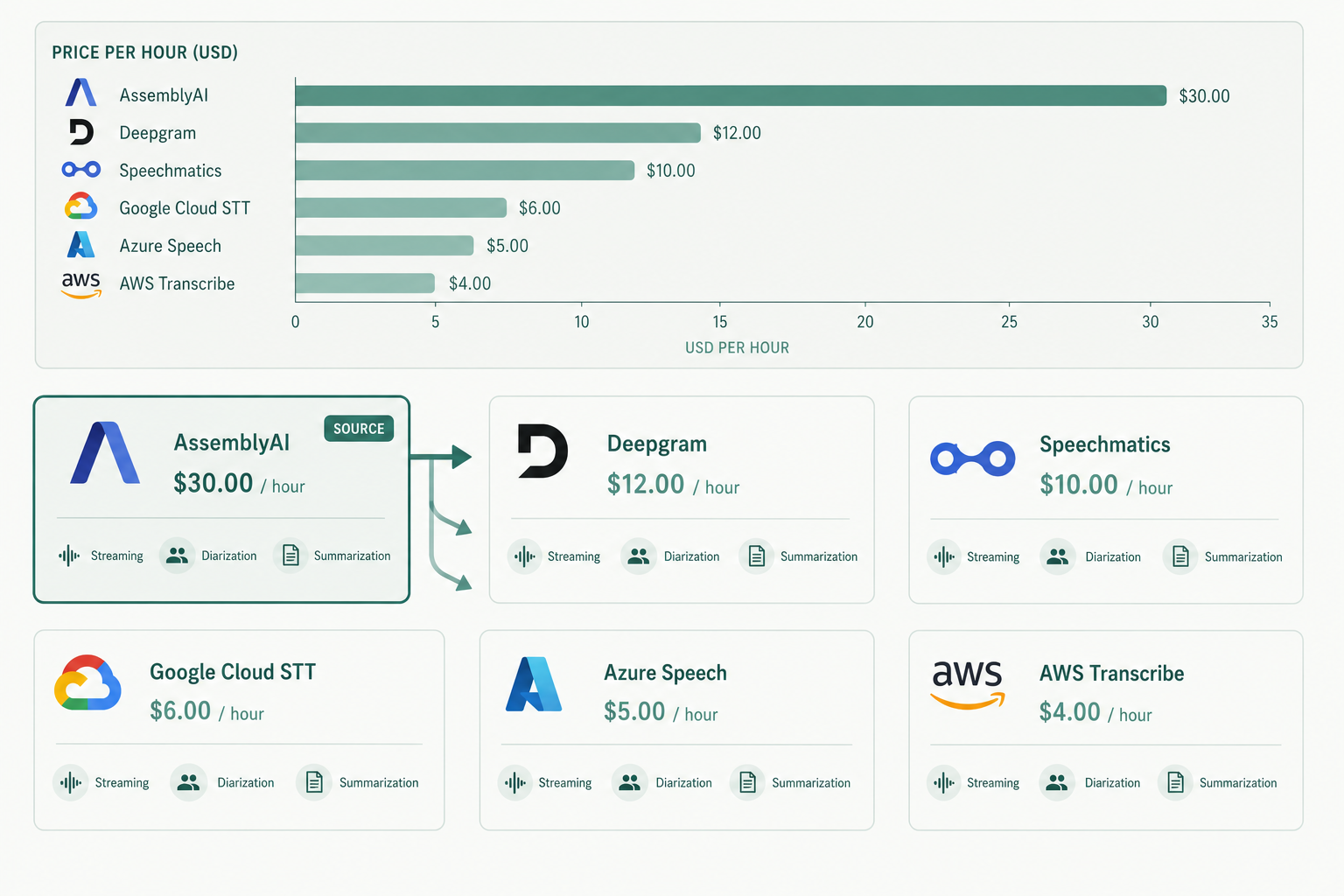
Most teams start on AssemblyAI because the SDK is clean and the docs are good. Then the audio hours stack up, and somebody pulls the bill into a meeting.
If you're in that meeting, this is for you. AssemblyAI is a solid product. It's also not the cheapest speech-to-text API on the market anymore, and it's no longer the only one with diarization, summaries, or word-level timestamps.
Six APIs are worth comparing before you switch. Here's the honest breakdown.
Who should look past AssemblyAI?
Stay if you're under a few hundred hours a month and you love the developer experience. The Universal model is genuinely good, the LeMUR intelligence layer is unique, and the per-hour rate barely registers on the credit card.
Look elsewhere when:
- Your monthly transcription bill is hitting four digits.
- You need sub-300ms streaming latency for a real-time product.
- You operate in a regulated environment that needs on-prem or self-hosted speech-to-text.
- You want flat-rate pricing for end users instead of a per-minute meter.
If you haven't actually used AssemblyAI yet, the AssemblyAI review with pricing breakdowns covers what each tier really gets you. This post is the contrast: everything else.
The shortlist at a glance
| API | Approx. price (async) | Streaming | Diarization | Notable strength |
|---|---|---|---|---|
| AssemblyAI | $0.12–0.37 / hr | Yes | Yes | LeMUR summarization |
| Deepgram Nova-3 | $0.26–0.46 / hr | Yes (low ms) | Yes | Streaming latency |
| Rev AI | $0.30–1.20 / hr | Yes | Yes | Studio-audio accuracy |
| Whisper (self-hosted) | GPU time only | No (batch) | Add-on | Full control |
| Google Cloud STT | $0.36–1.44 / hr | Yes | Yes | 100+ languages |
| Azure AI Speech | from $0.36 / hr | Yes | Yes | Custom acoustic models |
| VTS | Flat per file | No | Yes | Hosted Whisper, no subscription |
Prices come from each vendor's public pricing page and shift over time. Confirm with the vendor before signing anything.
The six alternatives in detail
Deepgram
Deepgram's Nova-3 model is the closest like-for-like to AssemblyAI: REST plus streaming plus diarization plus smart formatting. Most teams running live captioning or voice agents end up here.
Wins on: real-time streaming latency, custom keyword boosting, batch throughput. Pricing tends to come out cheaper than AssemblyAI's Universal tier on equivalent audio.
Falls short on: the post-processing intelligence features (summarization, sentiment) aren't as polished as LeMUR. Accuracy on heavily accented or noisy audio is good but not consistently better.
Official site: deepgram.com
Rev AI
Rev runs two products: human transcription at premium rates, and Rev AI at machine-API pricing. The machine model was trained on Rev's enormous human-transcribed corpus, and that pedigree shows up on clean speech.
Wins on: accuracy on studio-quality podcast and interview audio, strong verbatim options that respect filler words and disfluencies.
Falls short on: per-minute rate is higher than Deepgram or AssemblyAI's lower tiers. The dashboard is built for content teams more than developer ops.
Official site: rev.com/api
Self-hosted Whisper (and faster-whisper)
OpenAI open-sourced Whisper in 2022. The community has since built dramatically faster runtimes around it, and faster-whisper is the most production-ready. Run it on a single L4 or A10G and you're transcribing at 0.1–0.3× real time with zero per-minute cost.
Wins on: no API meter, full data residency, support for 90+ languages. Above roughly 2,000 hours/month, this is the cheapest viable option if you have engineering capacity.
Falls short on: you own the infra. Diarization needs a separate library like pyannote. Streaming isn't first-class. Whisper has known hallucination behavior on silence and music that managed vendors have engineered around.
Official site: github.com/openai/whisper
Google Cloud Speech-to-Text
Chirp 2 has closed a lot of the accuracy gap. If your stack already lives in GCP, the integration friction is zero, and the language coverage is the broadest of anything on this list.
Wins on: language breadth, long-form models for multi-hour requests, enterprise procurement. Right pick if you're transcribing support calls across 30 markets.
Falls short on: standard pricing is expensive at $1.44/hr. The default model isn't always as accurate as Deepgram on English. Tuning per use case takes real effort.
Official site: cloud.google.com/speech-to-text
Azure AI Speech
Azure's pitch is the same as Google's: you're already paying Microsoft for something else, this is a checkbox addition. Where Azure separates itself is custom acoustic models. You can fine-tune on your own domain audio without leaving the platform.
Wins on: custom model training, on-prem containers for regulated industries, sane base pricing.
Falls short on: documentation is heavier than Deepgram's, and the SDK ergonomics aren't as friendly. Speaker diarization can be inconsistent on overlapping speech.
Official site: azure.microsoft.com/products/ai-services/ai-speech
VTS
Full disclosure: VTS is our own tool. We built it because we wanted a hosted Whisper pipeline without a subscription, seat limits, or a per-minute meter that punishes archive ingestion. Upload a file, get a transcript with diarization and SRT export, pay flat per file.
Wins on: no subscription, speaker labels and SRT export included, predictable cost per file. Good fit if you don't want to run GPUs and don't need a streaming API.
Falls short on: it's an end-user app first, programmatic API second. For streaming or thousands of hours/day of bulk ingestion, the dev-first APIs above will fit better. Drop a file in to transcribe a file and see the output before committing.
What to weigh: accuracy, price, latency, ops
The accuracy gap between these APIs has narrowed sharply. On clean English audio you'll see word error rates in the 4–8% band across all of them. Differences show up at the edges: heavy accents, low signal-to-noise, code-switching, and overlapping speakers.
If you're switching on cost, do the math on actual usage instead of the headline rate. Streaming is priced higher than async almost everywhere. Diarization and word-level timestamps are sometimes paid add-ons. A 10,000-hour/month workload at $0.30/hr is $3,000; at $0.10/hr it's $1,000. The gap pays for an engineer.
Ops cost is the silent budget line. Self-hosted Whisper saves five figures a year over a managed API at scale, but eats two days of engineering a month when nobody owns it full time. Honest accounting includes that.
Which one should you pick?
- Stay on AssemblyAI if your bill is small and you love LeMUR. The developer experience is best-in-class.
- Pick Deepgram if you need streaming, low latency, or async throughput at the best managed per-minute rate.
- Pick Rev AI if your audio is studio-clean and you'll pay a premium for the lowest WER on podcasts and interviews.
- Pick self-hosted Whisper or faster-whisper if you have GPU budget, more than 2,000 hours/month, and an engineer willing to own the pipeline.
- Pick Google or Azure if you're already deep in that cloud and procurement matters more than the per-minute rate.
- Pick VTS if you want a hosted Whisper service without a per-minute meter or seat fees and don't need streaming.
Most teams end up running two of these in production: a managed API on the live path, and Whisper on the historical backfill. That hybrid is fine. Don't let purity push you onto one provider when the workloads have different shapes.
Paste any public link or upload a file and get a clean transcript in minutes. First 3 clips every month are on us — no card required.