The page nobody on a podcast wants to write is the only one Google, a brand-new listener, and a returning fan all read before deciding whether to press play.
Most show notes look like an afterthought — three bullets, a guest bio, an Apple link. The good ones do real work. They answer "what's this episode about?", they pull out every name and link the host and guest mentioned, and they give a returning listener a reason to come back.
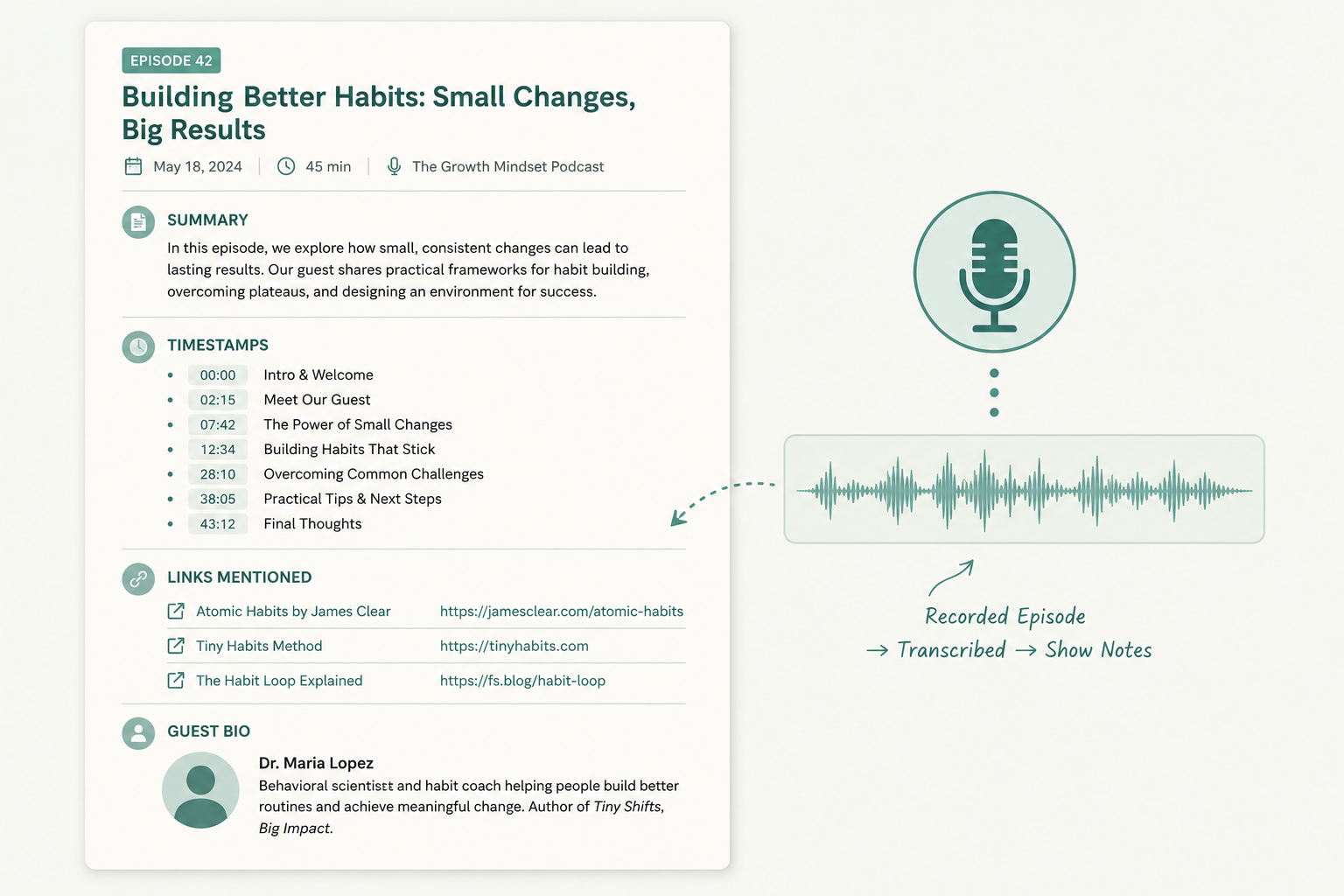
Here's a template you can lift straight from your transcript, with a filled example and quick notes on what each field is for.
- The template below works for interview, solo, and panel episodes. Drop the sections you don't need.
- Write the show notes from the transcript, not from memory. You'll catch every name and link the first time.
- Aim for 200-500 words for short episodes (under 30 minutes), 500-1500 for long-form.
- Add the full transcript as a collapsible section on the same page. Search engines index it; listeners can search inside it.
What show notes are actually for
Show notes have three jobs at once:
- Give a skimmer the gist in 10 seconds so they hit play.
- Surface every name, study, book, link, and tool the host or guest mentioned, in a form a search engine can index.
- Give a returning listener somewhere to land: a quote they loved, a timestamp they want to share, a follow-up to chase.
Most show notes do one of those three jobs. The ones that drive replays do all three on a single page.
The template (copy this)
# Episode {NUMBER}: {EPISODE TITLE}

{HOST} talks with {GUEST} about {ONE-SENTENCE PROMISE: what the listener will walk away with}.

**Listen:** [Apple]({APPLE_URL}) · [Spotify]({SPOTIFY_URL}) · [Overcast]({OVERCAST_URL}) · [RSS]({RSS_URL})

## In this episode

- {Concrete takeaway 1: a claim, not a topic}
- {Concrete takeaway 2}
- {Concrete takeaway 3}
- {Concrete takeaway 4}

## About the guest

{ONE PARAGRAPH on the guest: what they do, why they're qualified to talk about this topic, what they're known for. End with where to follow them.}

- Website: {URL}
- {Platform}: {URL}

## Timestamps

- 00:00 — Cold open
- 0X:XX — {Section title that names the actual idea, not "Intro" or "Chapter 1"}
- 0X:XX — {...}
- 0X:XX — {...}
- 0X:XX — Closing question

## Mentioned in this episode

- {Book/article/study} by {Author}: {one-line note on why it came up}
- {Tool or product}: {what it is, used for what}
- {Person/podcast/episode reference}
- {Concept or term}: {plain-English definition if the term is niche}

## Pull quote

> {The single most quotable sentence from the episode. 1-2 lines max.}
>
> — {Speaker}, {timestamp}

## Subscribe & say hi

If this episode landed, the best thing you can do is {one specific ask: share with a friend, leave a review, send a question for a future episode}.

- Email: {address}
- {Social}: {handle}

---

## Full transcript

<details>
<summary>Read the full transcript</summary>

{Speaker-labeled transcript, lightly edited for readability.}

</details>
A filled example
Here's the same template, filled for a fictional episode of a product-management podcast.
# Episode 47: Why Your Product Roadmap Lies to You

Maya Chen talks with Devon Patel about why most product roadmaps quietly drift from strategy within a quarter, and the two-question audit Devon uses to catch the drift before it ships.

**Listen:** [Apple](https://example.com) · [Spotify](https://example.com) · [Overcast](https://example.com) · [RSS](https://example.com)

## In this episode

- The signal that tells you a roadmap has gone off-strategy. It's not what most PMs look for.
- Why Devon kills any roadmap item that can't answer "what changes for the customer?" in one sentence.
- The "two-question audit" and the exact wording Devon uses in the planning doc.
- How a startup he advised cut their roadmap by 40% and shipped faster.

## About the guest

Devon Patel is the head of product at a mid-stage B2B SaaS company and writes the newsletter Build Less. He spent eight years at two earlier startups and has been talking about strategy-to-roadmap drift since long before it was cool.

- Website: https://example.com
- LinkedIn: https://linkedin.com/in/example

## Timestamps

- 00:00 — Cold open: the meeting where Devon realized the roadmap was lying
- 02:18 — What "strategy drift" actually looks like quarter by quarter
- 09:42 — The two-question audit, in full
- 17:05 — Walking through a real (anonymized) roadmap kill
- 28:30 — Why Devon won't ship a roadmap item without a customer sentence
- 35:55 — One piece of advice for first-time heads of product
- 41:10 — Closing question

## Mentioned in this episode

- Inspired by Marty Cagan: Devon credits chapter 9 for shaping the audit.
- Linear: used by Devon's team to track roadmap items vs strategy themes.
- "Working Backwards" memos, the Amazon practice Devon adapted for roadmap reviews.
- "Strategy drift": Devon's term for the slow gap between what a roadmap was meant to do and what it's now doing.

## Pull quote

> "If you can't write what changes for the customer in one sentence, you don't have a roadmap item. You have a wish."
>
> — Devon Patel, 17:42

## Subscribe & say hi

If this episode helped, the best thing you can do is share it with one product manager who's about to walk into roadmap planning.

- Email: [email protected]
- LinkedIn: https://linkedin.com/in/example

---

## Full transcript

<details>
<summary>Read the full transcript</summary>

**Maya Chen:** I want to start somewhere unusual. Tell me about the meeting where you realized your roadmap was lying.

**Devon Patel:** Yeah. So we'd just finished a quarterly business review...

</details>
How to write show notes from a transcript
The fastest way to write show notes that don't suck is to write them from the transcript, not from memory. You'll catch every guest name, study, and tool the first time, and you'll find your pull quote sitting there waiting.
Transcribe the episode end to end. Use a tool that gives you accurate podcast transcription with speaker labels and usable chapter timestamps.
Skim the transcript top to bottom and highlight every concrete claim, every named book, tool, or person, and any sentence that sounds like a pull quote.
From the highlights, write four takeaways. Each one should be a claim ("Devon kills any item that can't...") and not a topic ("On product roadmaps").
Pick chapter timestamps where the topic genuinely shifts, usually 4-7 chapters for an hour-long episode. Name the chapter for the actual idea, not "Section 2".
Pull every name and link the host and guest mentioned into the "Mentioned" list. Add a one-line note on why it came up.
Edit the transcript once for readability (drop fillers, repeated lines) and drop it under a collapsible <details> block on the same page.
That whole workflow is 20-30 minutes once the transcript exists. Without a transcript, it's an hour-plus of scrubbing audio for things you half-remember.
How long should show notes be?
For short episodes (under 30 minutes), aim for 200-500 words above the timestamp block. For long-form episodes (45+ minutes), 500-1500 words is normal. Apple Podcasts caps the in-app description at a few thousand characters, but the version on your own website can be longer, and that's the one Google ranks.
The two numbers that actually matter are: enough words for the page to be obviously about the topic, and a transcript on the same URL so the page has real content depth without padding the human-facing copy.
Do show notes help podcast SEO?
Yes, but not in a magic way. Podcast audio isn't indexed by Google in any useful way. The page that hosts the episode is, and a page with a thoughtful description, named topics, named people, named links, and a full transcript is the only thing Google has to figure out what the episode is about. That's why every podcast network with a marketing team puts the transcript on the page.
Put the transcript under the show notes, inside a <details> block so it's collapsible. The page stays scannable for humans; the transcript is still indexed by search engines, and visitors can ctrl+F to find a moment they remember. The transcript also doubles as raw material for everything downstream: blog posts, social clips, newsletter excerpts. We wrote about getting more out of one transcript if that's the part you want to lean into.
If you're investing in a podcast and skipping the show-notes page, you're paying for a microphone and ignoring the part that's actually free to optimize.
Common mistakes that kill replays
- Timestamps with no idea attached. "0:00 Intro / 5:00 Topic 1" tells nobody anything. Name what's happening at that minute.
- A guest bio that reads like LinkedIn. Three sentences about credentials, zero about why this person on this topic. Lead with the relevance.
- No pull quote. It's the single highest-share asset from your episode. Pick it from the transcript while you're already there.
- No links to anything mentioned. Half the value of the show notes is the resource list. If someone wants to chase a book the guest mentioned, they shouldn't have to scrub audio to spell the title.
- A wall of fluff with no transcript. Add the transcript. It quietly does the SEO work the prose can't.
If accuracy matters (and on a podcast where people get quoted, it does), edit the AI pass once before publishing. Names and proper nouns are where machines still miss.
Paste any public link or upload a file and get a clean transcript in minutes. First 3 clips every month are on us — no card required.